
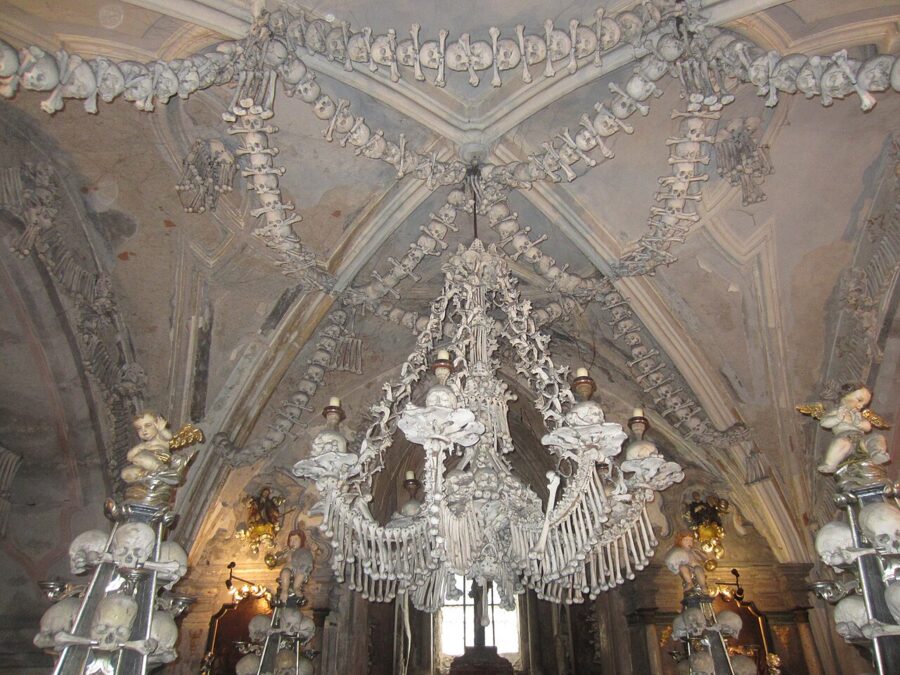
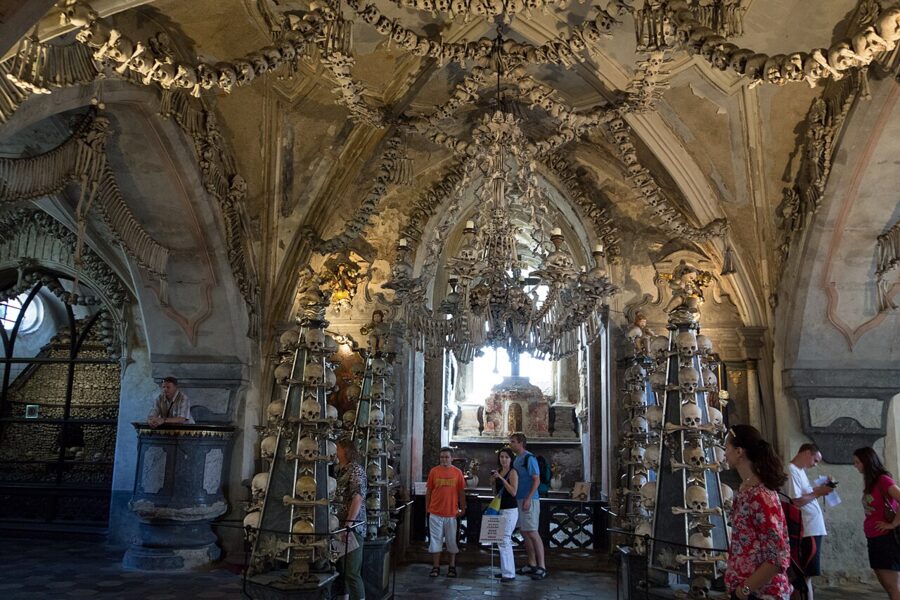
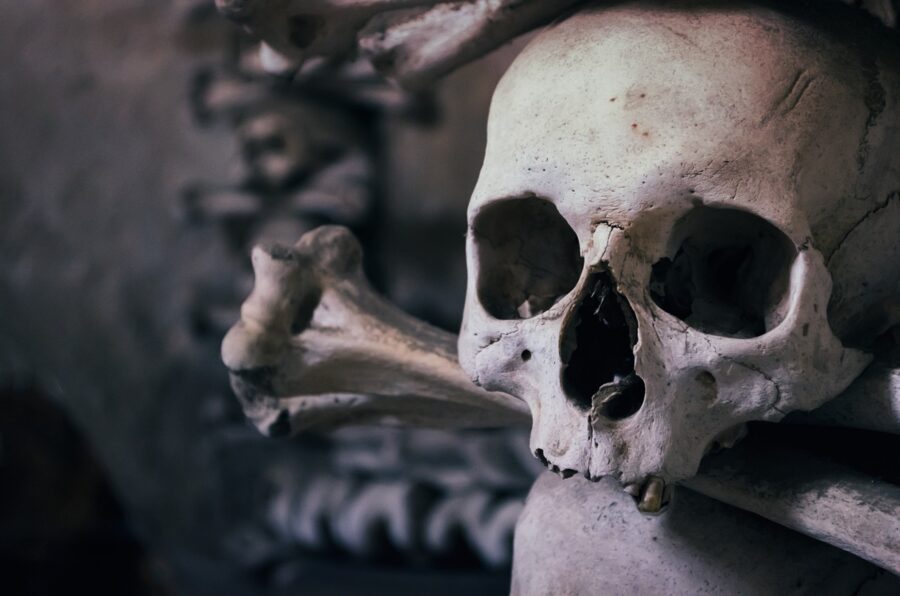
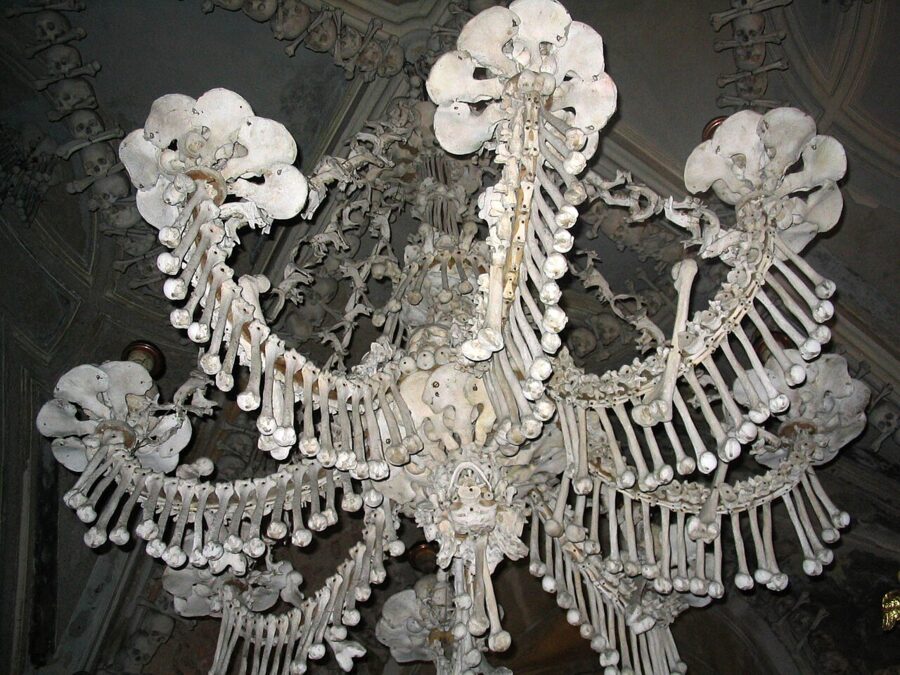
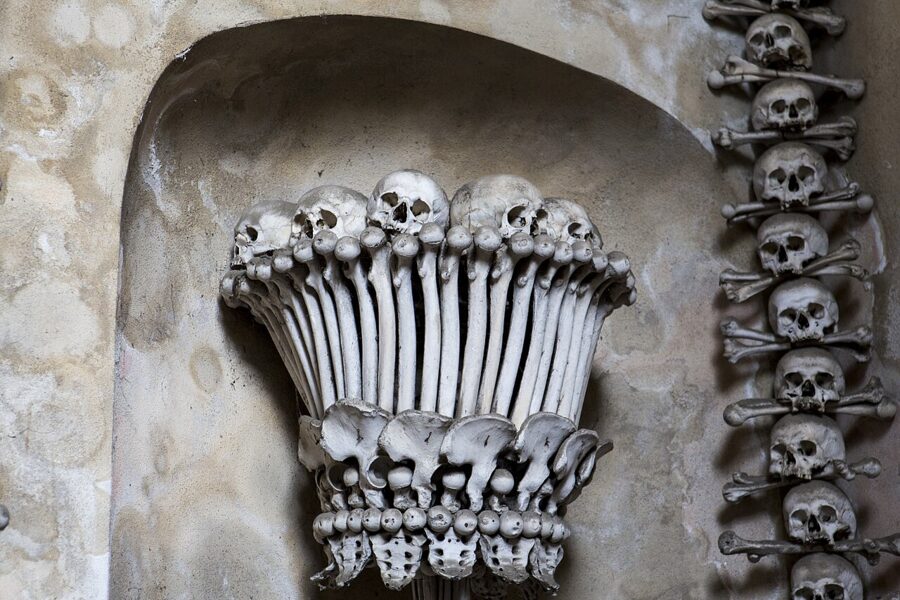
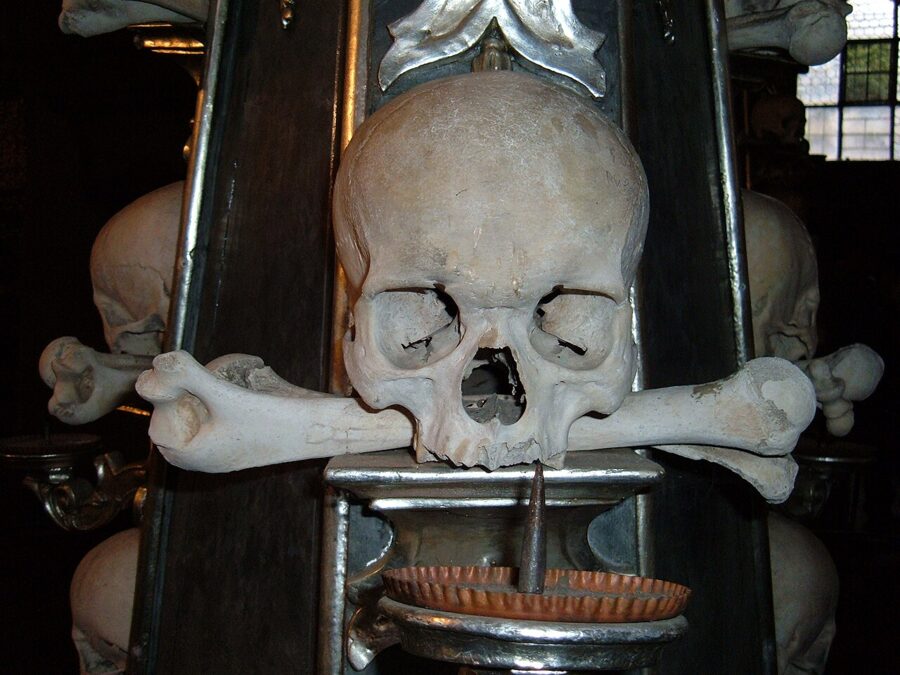
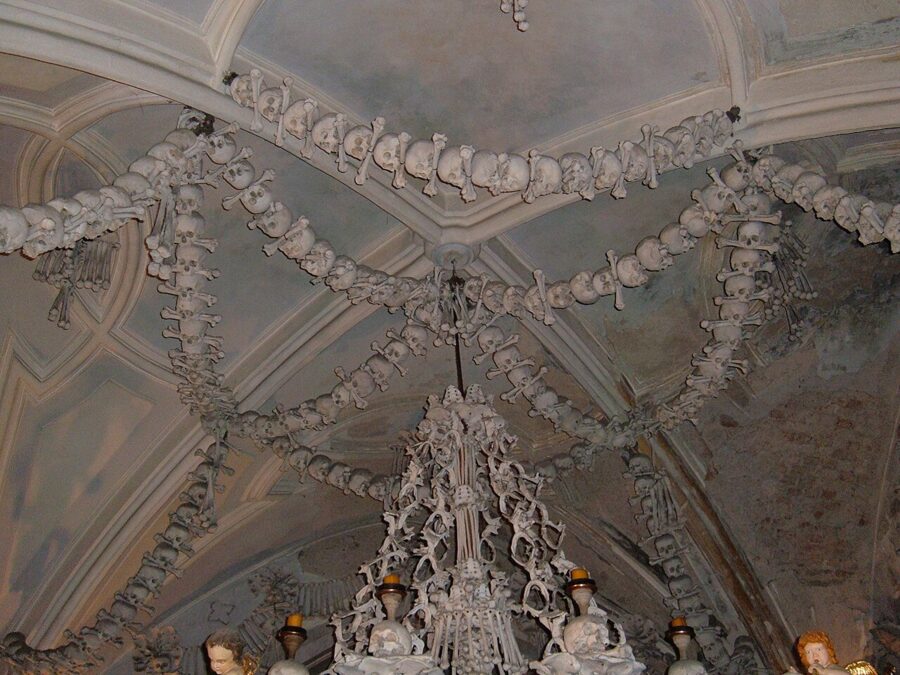
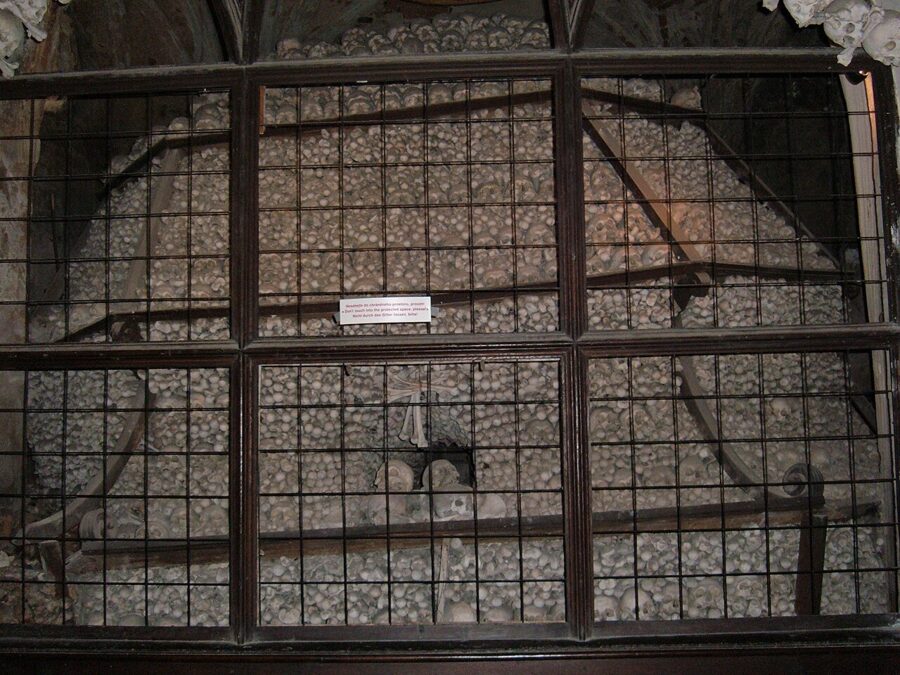
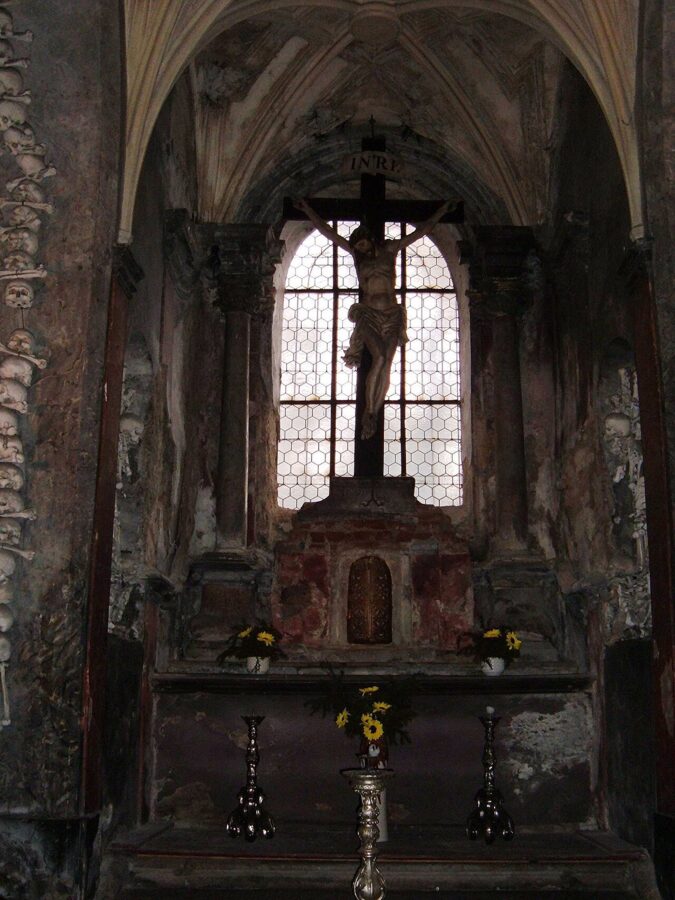
A chandelier hangs from the vault of a small chapel in Sedlec, on the edge of Kutná Hora, and it is said to hold at least one of every bone in the human body. Skulls serve as its candle cups. Garlands of skulls loop across the ceiling around it, and in the four corners of the room stand pyramids of stacked bones about five meters (16 feet) high.
Estimates of how many people are in this room run from 40,000 to 70,000. A count published in 2016 put the skulls alone at 56,000 to 60,000, with 420,000 to 450,000 long bones. Nobody knows their names. What the parish does know is that they asked to be buried here, in a cemetery believed to be holy ground.
This is the Sedlec Ossuary (Kostnice Sedlec), the lower chapel of the Cemetery Church of All Saints, and it is still a working Roman Catholic church. Since 2014 it has also been a building site, and from November 2026 part of the room is screened off. I would still go, on the first timed slot of the morning, with the phone left in my pocket: photography has been banned since 2020.



In this case9 parts
- IWhat the Sedlec Ossuary is
- IIHow the bones got there: the legend and the record
- IIIFrantišek Rint and the decoration
- IVWhat the bones are, and how they are cared for
- VThe restoration, 2014 to at least 2030
- VIVisiting the Sedlec Ossuary in 2026
- VIIThe Cathedral of the Assumption across the road
- VIIIKutná Hora around it
- IXGetting there from Prague
What the Sedlec Ossuary is
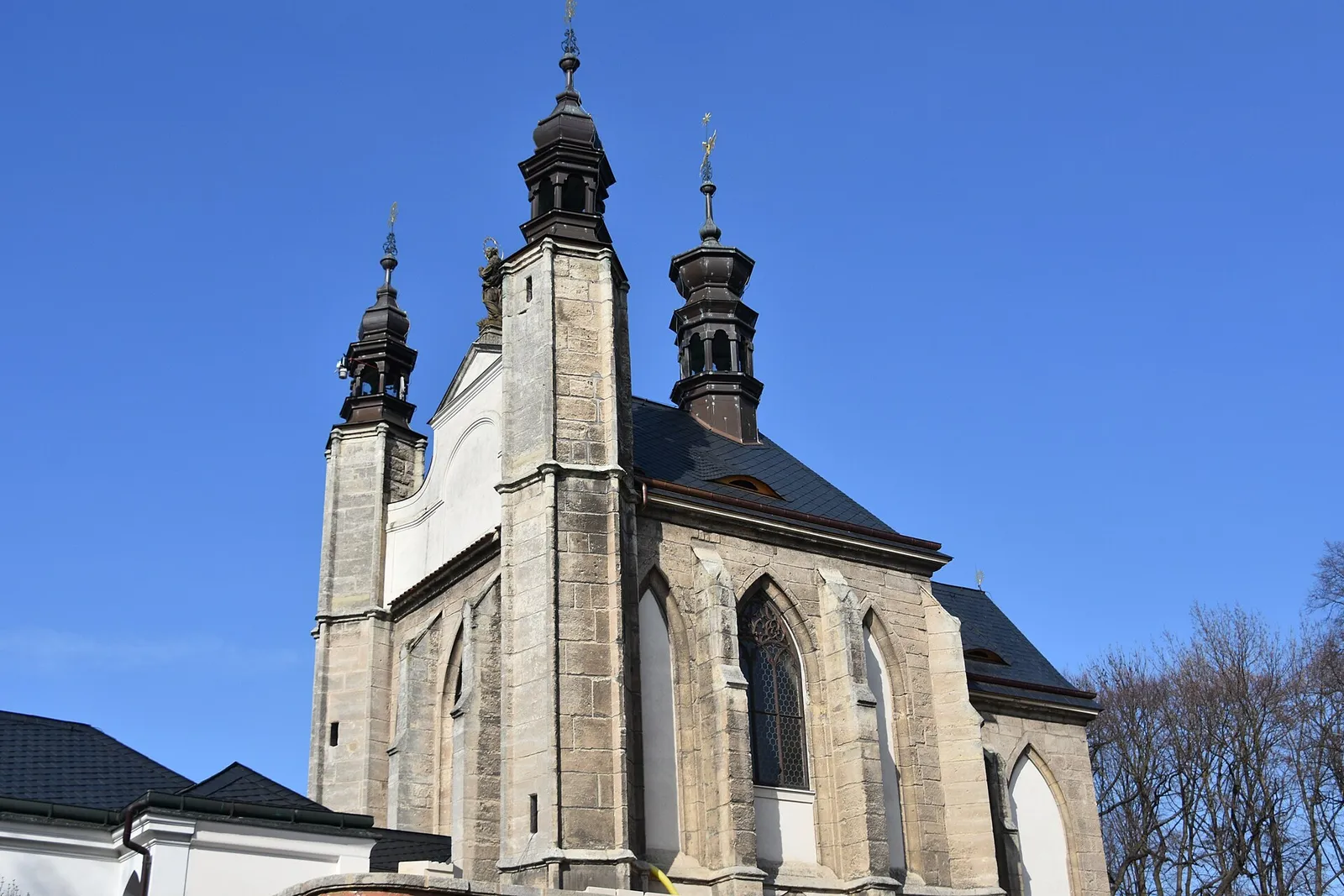
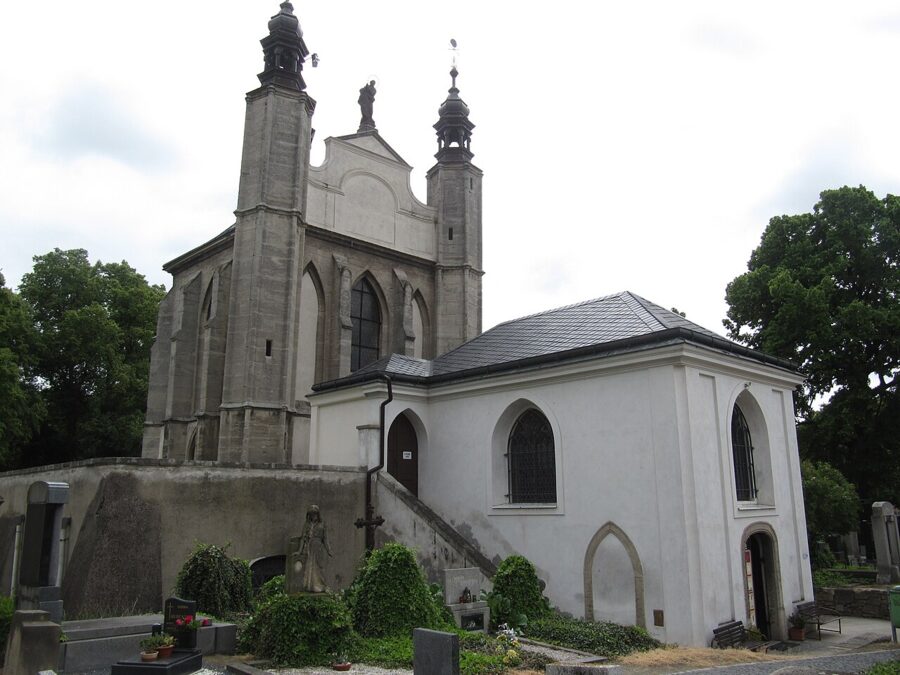
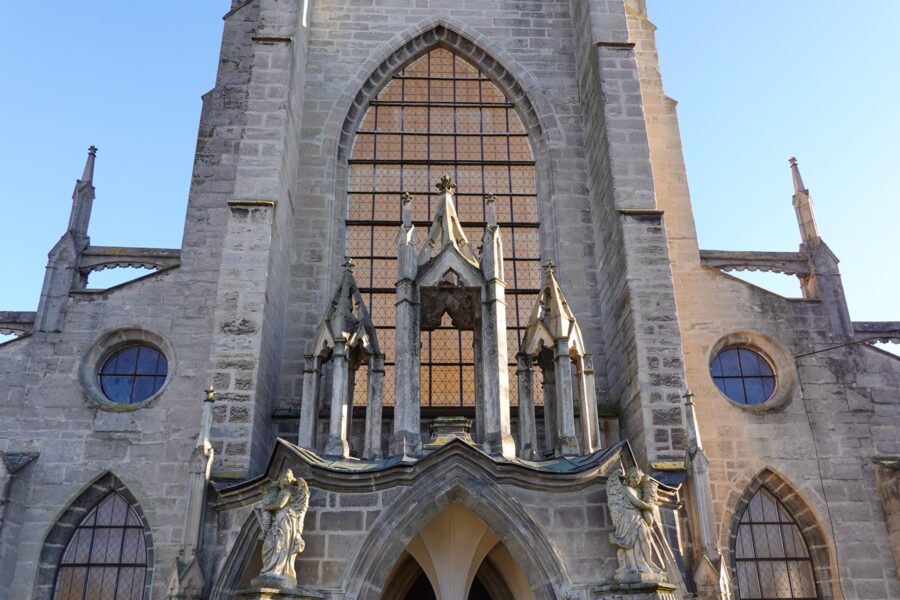
The building is two chapels stacked one on top of the other. The upper chapel, full of light, was for Masses said for the dead. The lower one was built below ground level from the start, because Christian custom required exhumed bones to rest under the earth. The parish dates the Gothic church to the first half of the 14th century; other accounts put it nearer 1400, and nobody has found a record of the year it was finished.
It stood in the middle of the cemetery of Sedlec Abbey, founded in 1142 as the oldest Cistercian monastery in what is now the Czech Republic. Pilgrims came from across Europe, and an eternal light burned in the lanterns of the two west towers as a beacon for them. Look up at the tips of those towers: they carry skulls, and the slender turret at the east end carries an angel on its weathervane.
One distinction matters if you collect World Heritage Sites. Kutná Hora’s UNESCO inscription names the historic town center, St. Barbara’s Church and the Cathedral of Our Lady at Sedlec, which stands a few hundred meters away; the ossuary itself lies outside the protected zone. It draws the crowds anyway: almost 500,000 people in 2019, and 297,000 in 2022.

How the bones got there: the legend and the record
A handful of holy soil
The story goes that the king of Bohemia sent the abbot of Sedlec, Heidenreich (Jindřich in Czech), to Jerusalem, and that he came home with a handful of earth and scattered it over the abbey cemetery. The year usually given is 1278. Most retellings say the soil came from Golgotha. The parish’s own history of the ossuary names a different place: Hakeldama, the potter’s field outside Jerusalem that the Gospel of Matthew says was bought with Judas’s thirty pieces of silver as a burial ground for strangers.
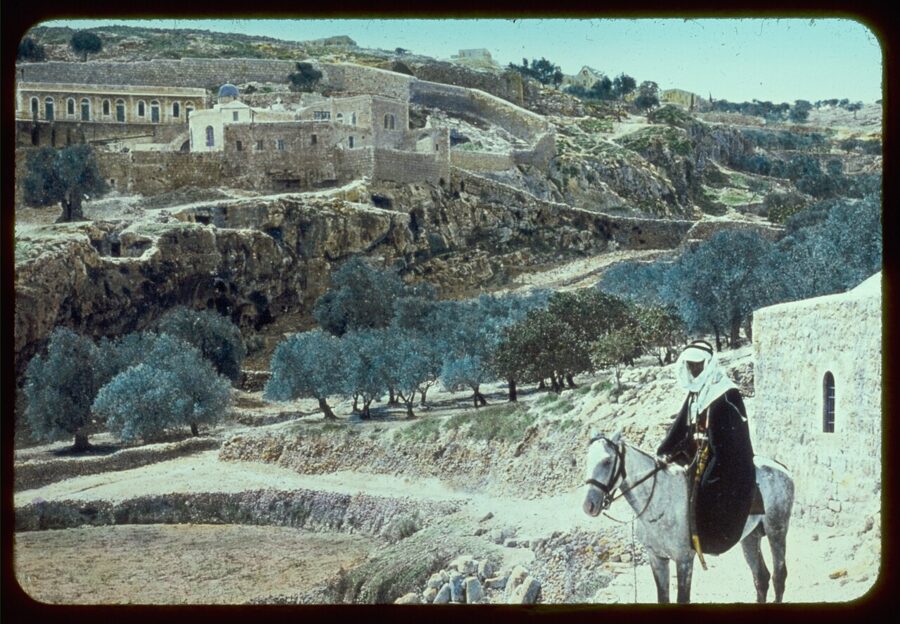
Either way, Sedlec became holy ground, the first in Central Europe according to the parish, and people wanted to lie in it. The abbey had other reasons to prosper: in the second half of the 13th century one of its monks found silver on abbey land, and the mining town of Kutná Hora grew up around the find.
Famine, plague and the Hussite wars
Then the dead arrived in numbers. The parish’s history counts up to 20,000 deaths in the famine of 1318, about 30,000 in the plague three decades later, and some 10,000 in the Hussite wars of the early 15th century, when the abbey’s cathedral was burned in 1421. Those figures come from chroniclers and should be read as orders of magnitude.
The ground itself has since been counted. During the restoration, archaeologists excavated mass graves around the church, and by May 2018 they had recorded 1,656 skeletons from the 14th to the 16th centuries. Jan Frolík of the Czech Academy of Sciences called it the largest burial ground ever excavated in Bohemia. Some of the dead still had coins on them, because nobody had dared to search plague victims, and men outnumbered women, as you would expect in a mining town.
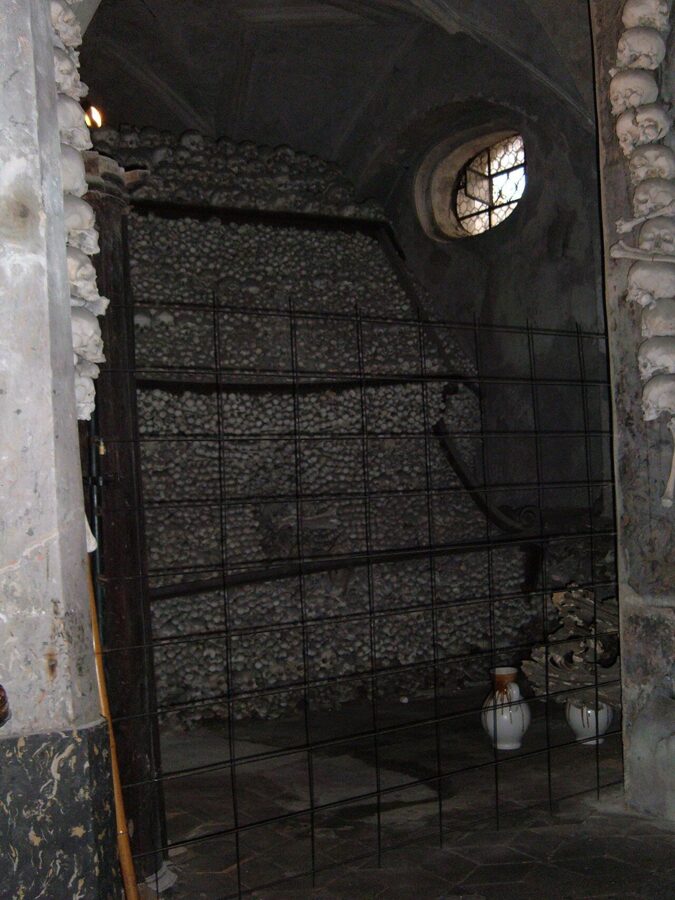
The parish now puts the total at nearly 1,850 medieval burials. Researchers link the older mass graves to the famine of 1318 and the younger ones to the Black Death of 1348 to 1350. When the cemetery could grow no further, old graves were emptied and the bones were piled loose along the walls of the lower chapel, inside and out.
The half-blind monk
Almost every account of Sedlec tells you that in 1511 a half-blind monk of the abbey began stacking the loose bones into the first pyramids. No document has turned up to prove it, and the parish’s history does not repeat the story. What the records do show is the architect Jan Blažej Santini Aichel, who rebuilt the burned cathedral in the early 18th century for Abbot Jindřich Snopek and repaired All Saints at the same time.
The parish credits Santini with the concept of the bone decoration as you see it: four pyramids as the mountain of heaven, a crown above each as the gate to the heavenly kingdom, death set inside a divine order with the promise of resurrection. It is a different kind of place from the Catacombs of Paris, where a city emptied its cemeteries into an old quarry; at Sedlec the bones never left the graveyard they were buried in.

František Rint and the decoration
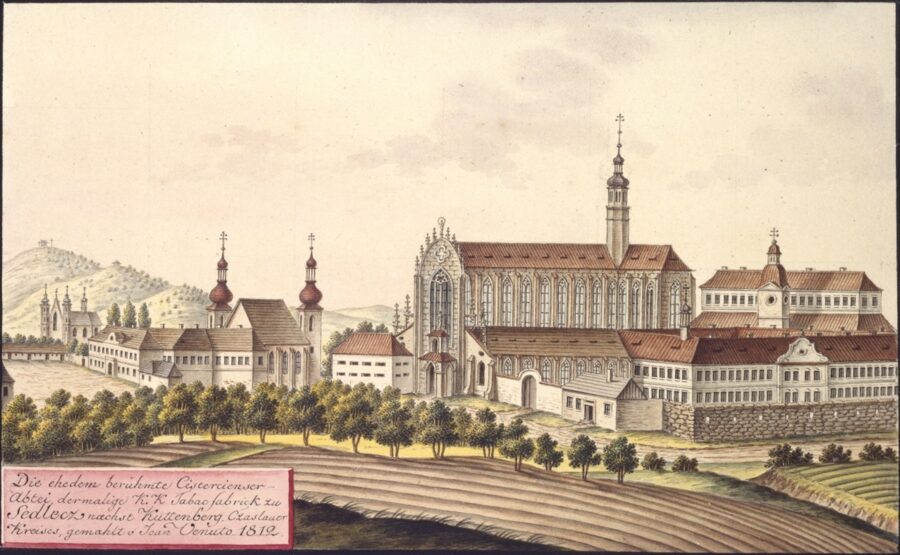
In 1783 Emperor Joseph II dissolved the abbey. Its property was auctioned off, the cathedral became a warehouse, tobacco was processed in the monastery, and the Schwarzenberg family took over the patronage of All Saints. The cemetery was shrunk again, and the bones from the cleared graves went partly into the ossuary and partly into a common grave.
The Schwarzenbergs paid for a full restoration of the ossuary in the 19th century, and before 1870 they brought in František Rint, a woodcarver from Česká Skalice. Rint took Santini’s restrained baroque scheme and remade it in the spirit of Romanticism, using every kind of bone in the body. The parish describes the result without much affection: a place where the dead waited in hope was turned into a realm of triumphant death.

The chandelier, the arms and the signature
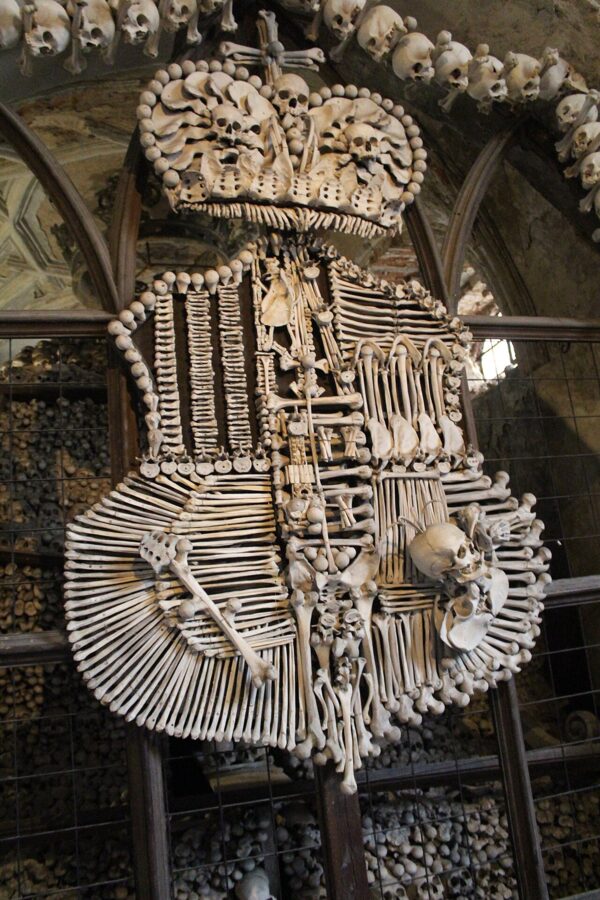
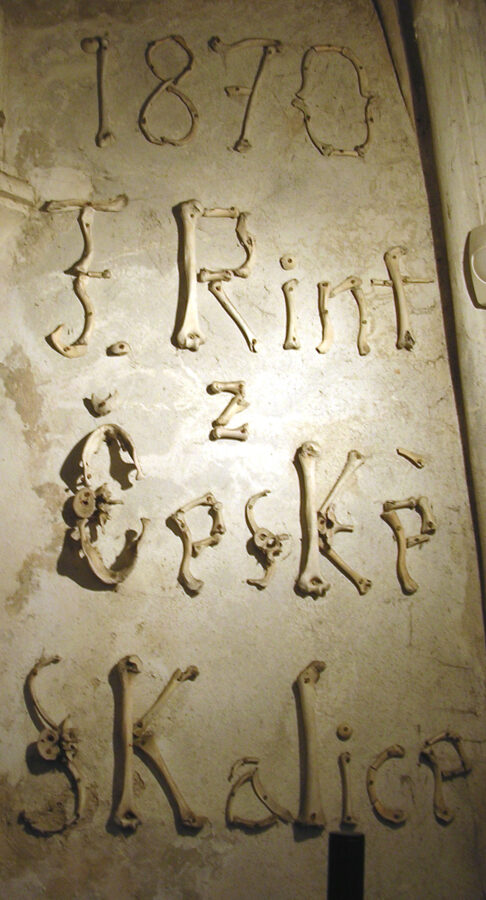
Rint’s best-known work is here: the chandelier, the hanging garlands and the Schwarzenberg coat of arms. He also made bone chalices, a monstrance and crosses, and he signed the job on a wall with his name, his hometown and the year 1870, laid out in bones. The parish says the chandelier “allegedly” holds every bone of the human body, which is the right word.




What the bones are, and how they are cared for
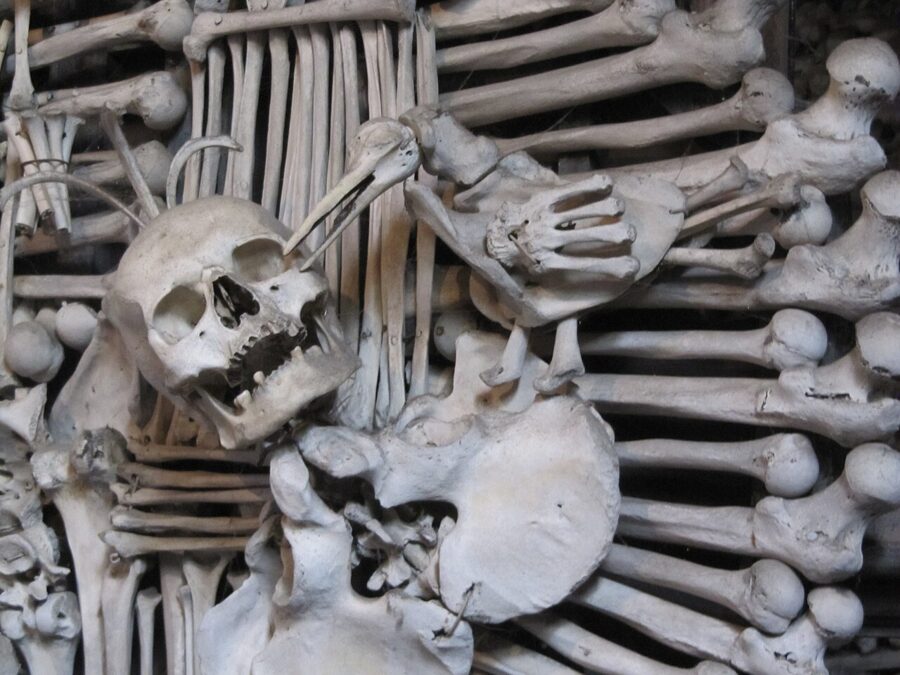
Every bone in the room is real; the parish’s visitor rules say so in as many words, because people still ask.
They are also fragile. In March 2016 the chandelier came down, close to collapse. Restorer Tomáš Král found its bones fixed to the wooden frame with rusted nails, and he could save the bones or the wood, not both.
He cut the nails out of the wood, had the frame copied exactly from drawings and photographs, and set the bones in notches. The chandelier went back up on 24 November 2016, as the business daily E15 reported that evening.
The pyramids get the same treatment. Each bone is washed by hand under low water pressure and scrubbed with nylon brushes, then soaked in lime water, which disinfects it and hardens it. It is dried under big fans and boxed until it goes back. Fragments crushed by centuries of weight are reburied, and no replacement bones or casts are used to fill gaps.

The restoration, 2014 to at least 2030
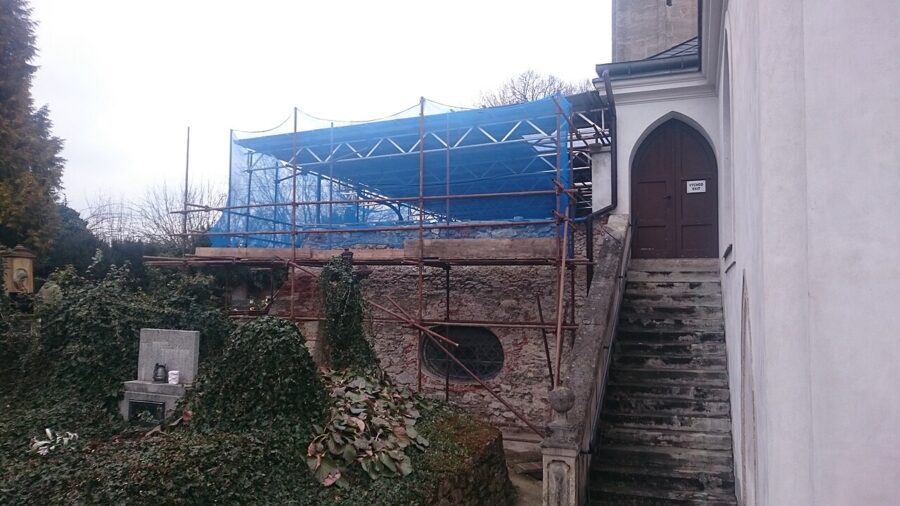
The church leans. The tower wall stands up to 460 millimeters (18 inches) out of vertical, because the soil it sits on carries up to 2.7 times the load it can bear and the pillar foundations have sunk 150 to 200 millimeters. Santini already tried to correct it by adding the entrance hall to the west front. The other problem was damp: no waterproofing in the walls or floor, and water condensing under the flat terrace roofs.
Work began in 2014, and the parish has kept the ossuary open throughout, partly so that you can watch and partly because tourism pays for all of it. The parish’s record of the repairs lists more than CZK 136 million (about US$6 million) spent by the end of 2025, with no other investor.

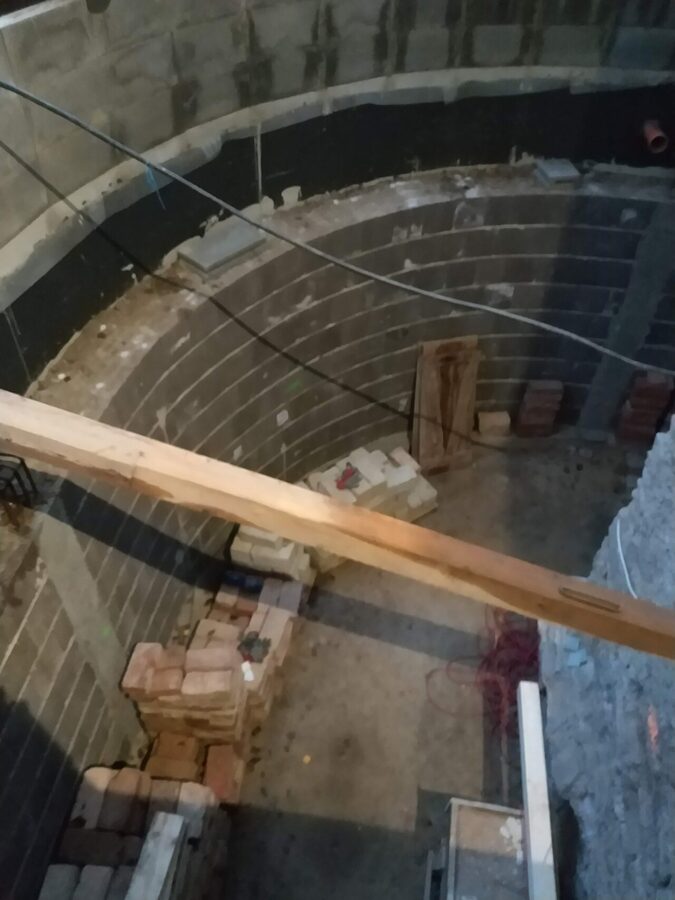
The pyramids are the hard part. The northwest pyramid was taken apart layer by layer between January and March 2019, and it filled 1,500 boxes. Reassembly began in July 2022 around a new internal timber frame, because the bottom layers were being crushed.
Clear plastic formwork let Král check each tier as it rose, and the pyramid was essentially finished in June 2024 at a cost of CZK 21 million, as reported from the press presentation.
The southwest pyramid came down in July 2023. Under it, archaeologists found 19 grave pits and lifted 17 complete medieval burials. Its reassembly began in July 2025. In late 2025 the parish removed the main staircase into the lower chapel, built in the 1970s, put two temporary timber staircases under the pointed windows, and introduced timed entry slots.


Visiting the Sedlec Ossuary in 2026
Tickets
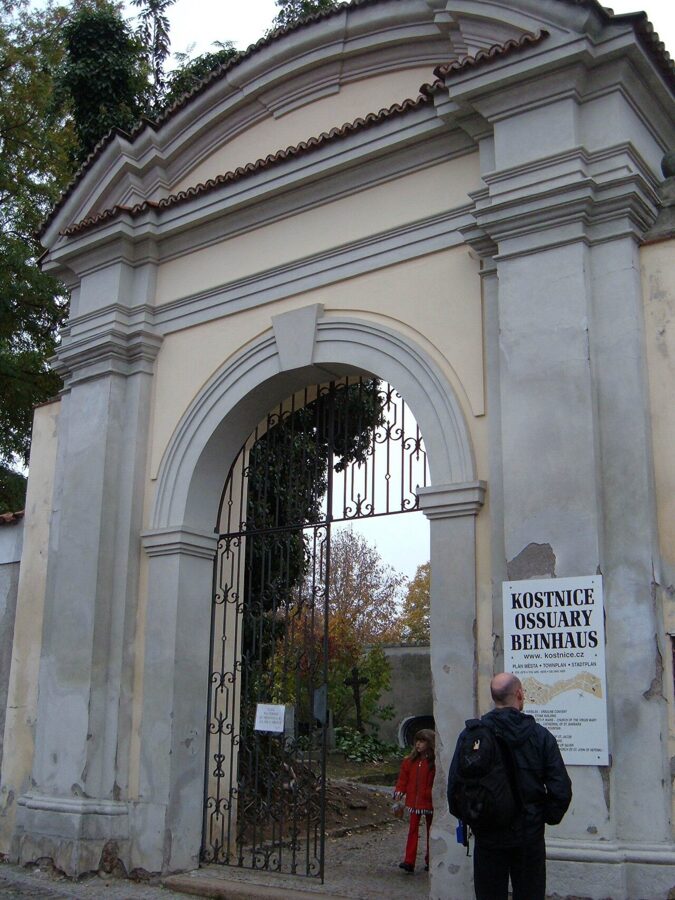
Tickets are sold for a specific date and time, online at the parish’s official Sedlec ticket site or at the Sedlec Information Center, Zámecká 279. The parish warns that it is the only official seller and that resellers charge several times the price. Without a booking, entry is not guaranteed.
From November 2026 until the end of April 2027, the space between the pyramids is closed while the new staircase, damp-proofing and floor go in. The route is shorter, each slot takes no more than 70 people, and the price has dropped from the usual CZK 220 (about US$10) for adults, according to the national tourism portal’s notice on the restricted route. Prices as of November 2026, from the parish’s visitor page:
| Ticket | Adults | Students and seniors | Children and disability (ZTP) card holders |
|---|---|---|---|
| Sedlec Area: ossuary (both chapels) and the Cathedral of the Assumption | CZK 180 (about US$8) | CZK 120 | CZK 80 |
| Sedlec Area plus St. Barbara’s Church | CZK 360 (about US$16) | CZK 270 | CZK 120 |
The ossuary ticket covers the cathedral too, and the cathedral visit can be used within three days. The cathedral on its own costs CZK 150 for adults.

Opening hours
| Months | Ossuary hours, daily |
|---|---|
| April to September | 9:00 to 18:00 |
| March and October | 9:00 to 17:00 |
| November to February | 9:00 to 16:00 |
Hours as of November 2026. The ossuary closes on 24 December, and night tours run on set dates.
The rules
No photographs, anywhere in the Sedlec monuments. The parish announced the ban in October 2019 after years of selfies taken with skulls and of people handling bones, and the rule stands today. “This is not a bizarre castle of horror,” Radka Krejčí of the Sedlec parish told Czech Television, and she said the parish would accept fewer visitors rather than change its mind.
The rest of the rules follow from the fact that you are in a tomb. No touching, no food or drink, no smoking in the cemetery, quiet voices, and clothes that respect a working church. Nobody under the influence of alcohol or drugs is let in, and no dogs. Large bags and motorcycle helmets are not allowed in the lower chapel, so leave them in the lockers at the Information Center; strollers are allowed, but you carry them down yourself.
Since 1 October 2025 there is no step-free access to either chapel. The only way into the lower chapel is a temporary timber staircase, and the parish says plainly that the ossuary is not wheelchair accessible for now.

How long to allow
Arrive about five minutes before your slot and no later than ten minutes after it, or you may not get in. The lower chapel has a limit of 30 minutes, which is plenty while the middle of the room is closed; the upper chapel has none. Times cannot be changed, and tickets can only be cancelled up to three days ahead, for a voucher valid 12 months. With the cathedral, I would give Sedlec an hour and a half, and Kutná Hora the rest of the day.

Memento mori, opening in 2027
Archaeologists found those 1,850 burials in the ground beside the lower chapel, and that space is becoming an underground exhibition called Memento mori. The parish’s repair record gives 1 April 2027 as the opening date; its exhibition page was counting down to 1 May 2027 in November 2026. It is built around one question, “What do we regret most before we die?”, with recorded reflections from visitors and local people. For human remains shown in a medical setting rather than a sacred one, the Mütter Museum in Philadelphia is the counterpart.
The Cathedral of the Assumption across the road
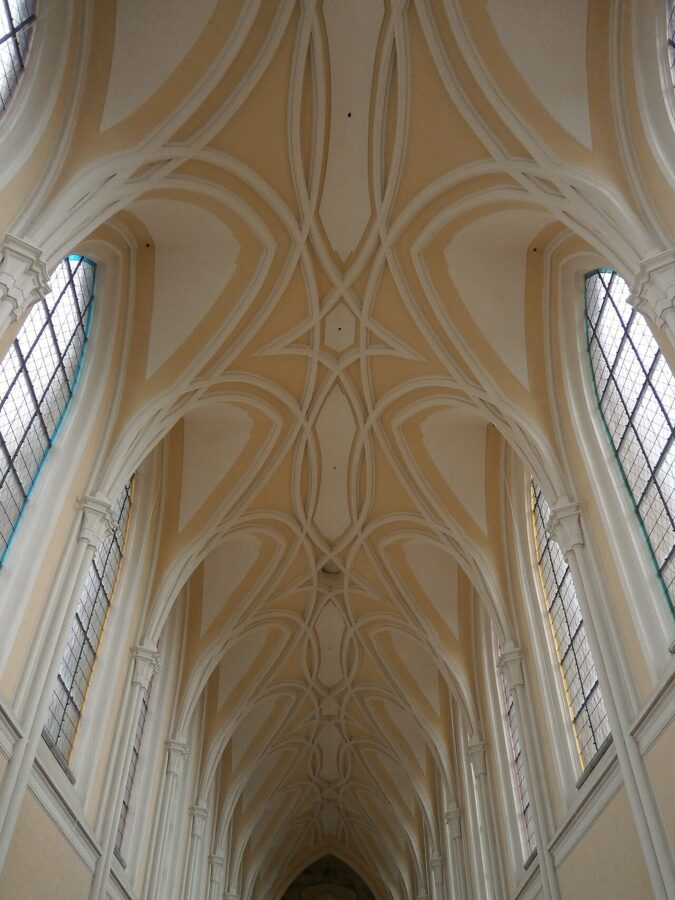
Your ticket also opens the Cathedral of the Assumption of Our Lady and Saint John the Baptist, a short walk south past the Information Center. The abbey built it between 1290 and 1320, the Hussites burned it in a single night in 1421, and it stood as an abandoned shell for close to three centuries. Santini rebuilt it in the early 18th century in the style known in Czech as Baroque Gothic: Gothic lines with Baroque ornament. It is the half of Sedlec that UNESCO listed, in 1995.


Kutná Hora around it
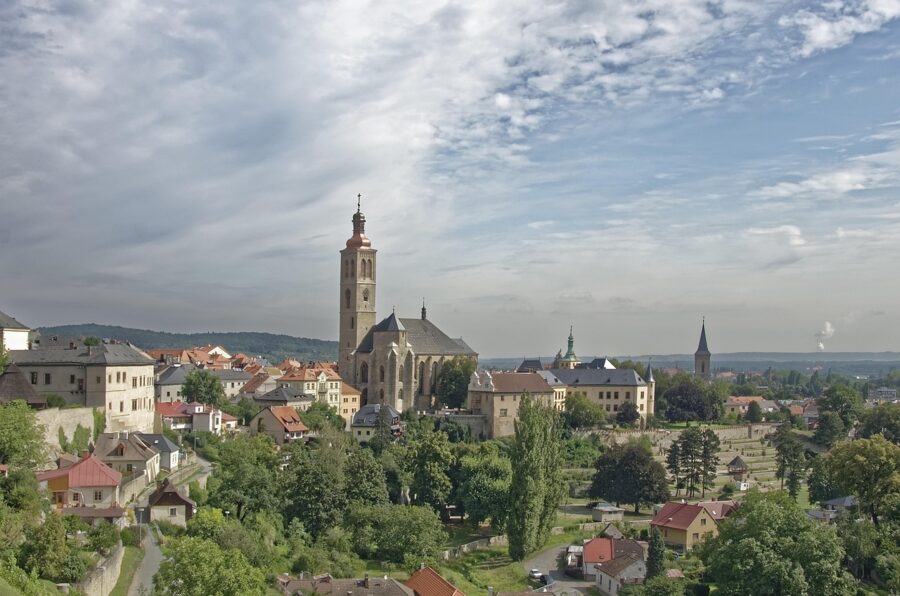
Kutná Hora exists because of silver. UNESCO’s description is short: the mines made it a royal city in the 14th century, endowed with buildings that showed off its wealth. Sedlec is now a suburb about 2.5 kilometers (1.5 miles) from the old town, and most people combine the two.
St. Barbara’s Church
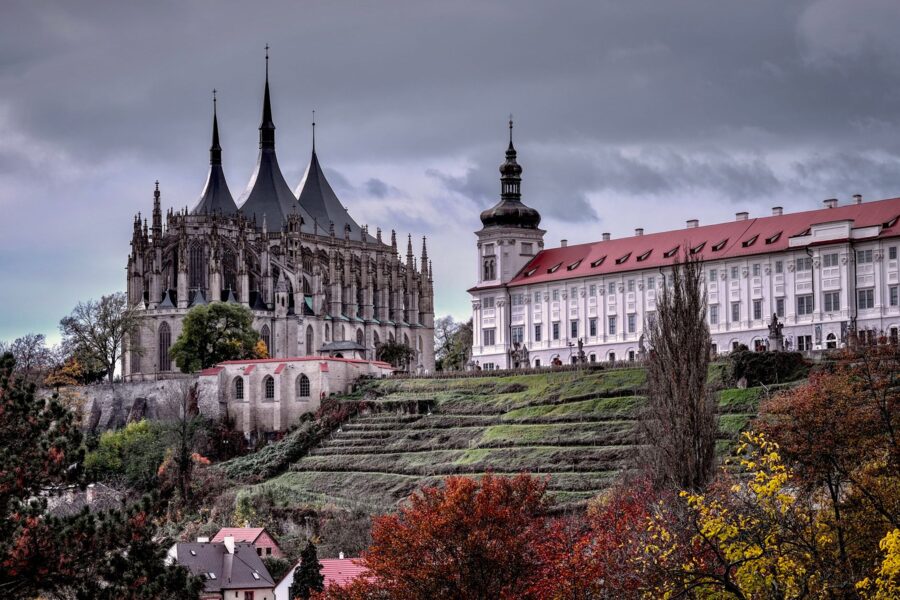
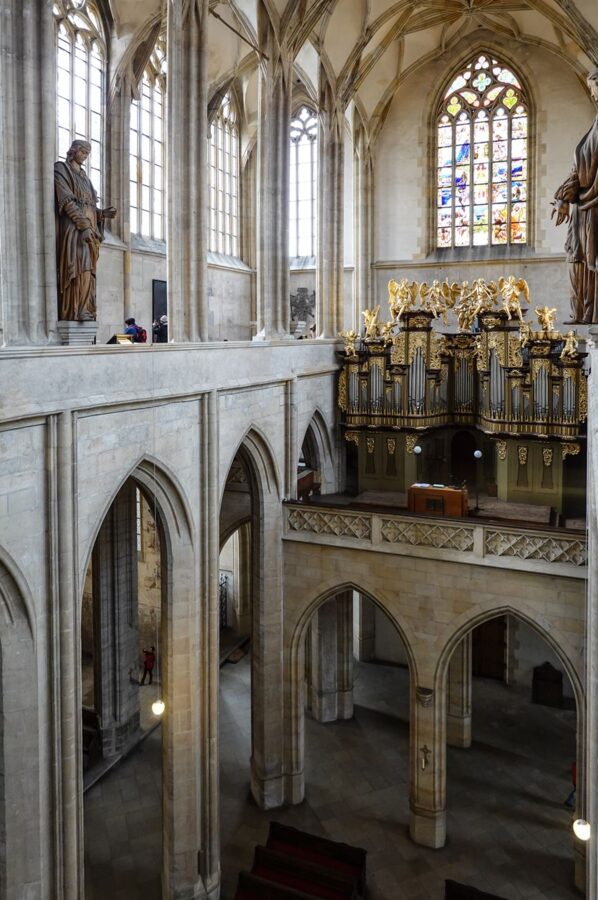
Saint Barbara is the patron of miners, and the miners paid for her church. Work began in 1388 under the Parler workshop, stopped when the silver ran out, and was only completed in the neo-Gothic restoration at the turn of the 20th century. Inside are frescoes of miners and minters at work. Tickets for the church are CZK 180 for adults, CZK 140 reduced and CZK 60 for children from six, as of November 2026.
It opens daily, 9:00 to 18:00 in the April to October season and from 10:00 in winter, closing at 16:00 in January and February and at 17:00 in other months. It closes on 24 December and keeps a list of changes to the opening hours for Masses and concerts. In December 2026 it closes early on 5 December and stays shut on 6 December.
The Italian Court
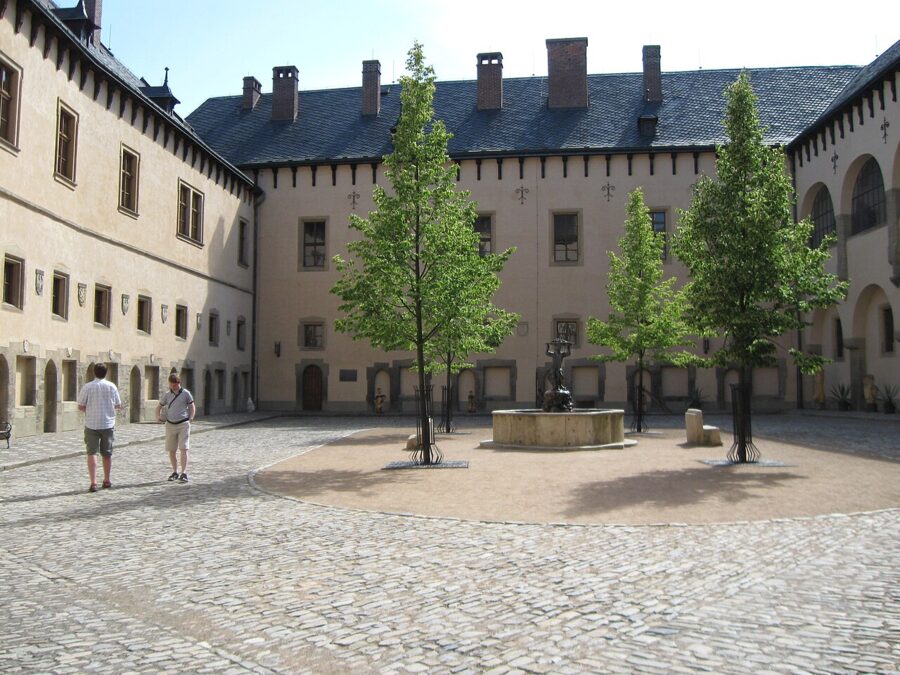
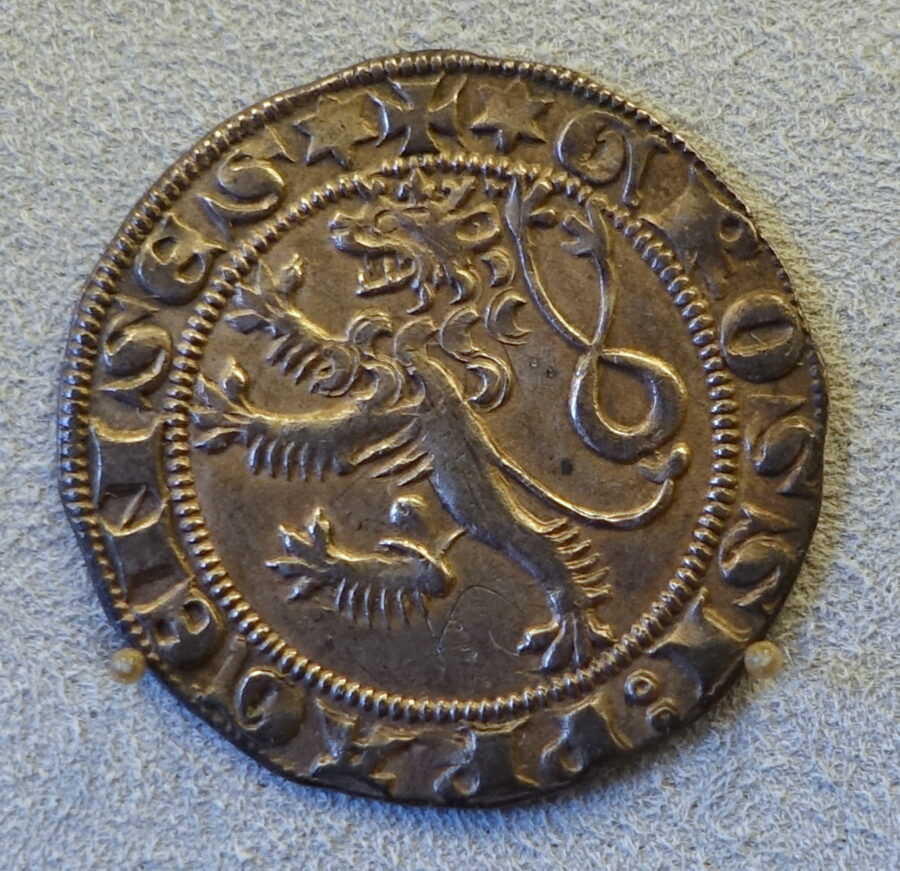
The silver was turned into coins at the Italian Court (Vlašský dvůr), the royal mint founded by King Wenceslas II, which was also a royal palace and now houses the town hall. The town’s guide service runs the tours: the Royal Mint route alone costs CZK 120, and the combined route through the cellars, mint and palace costs CZK 220 in Czech or CZK 260 with an English-speaking guide, as of November 2026. Hours are 9:00 to 18:00 in the April to September season and 10:00 to 17:00 the rest of the year, with a lunch break from 11:45 to 12:15.

Getting there from Prague
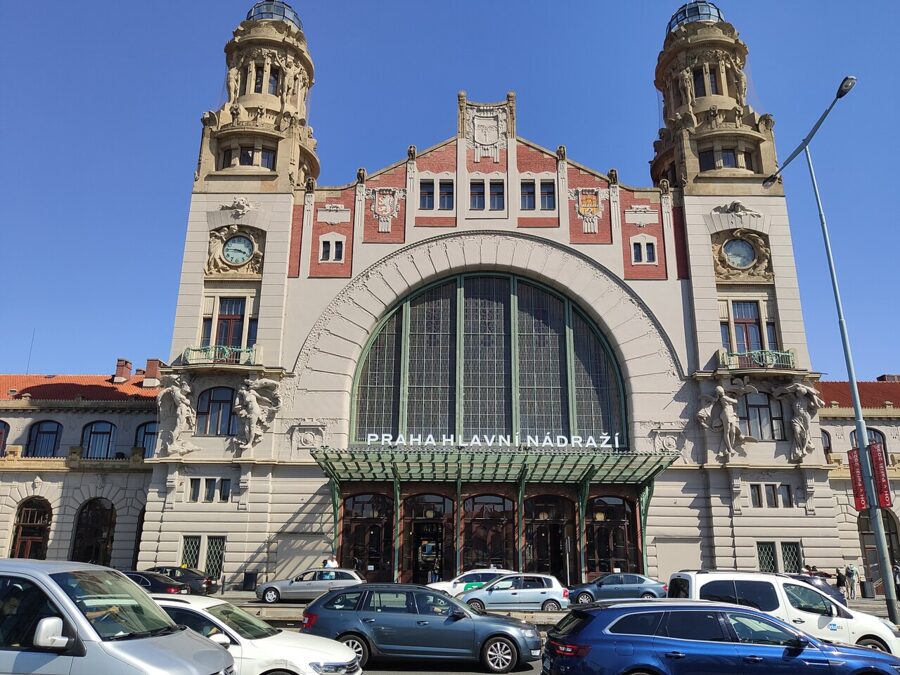
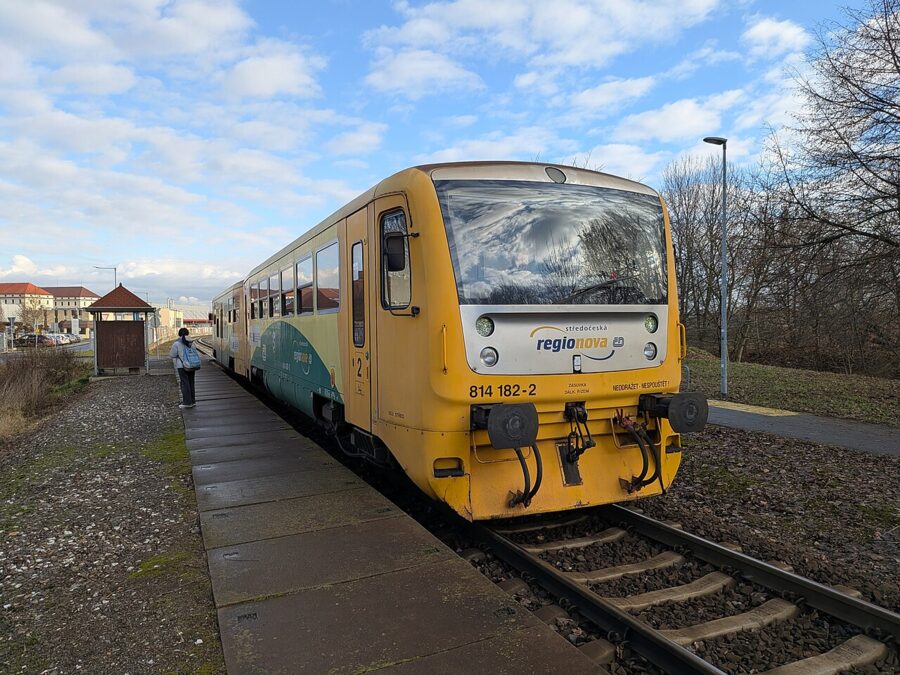
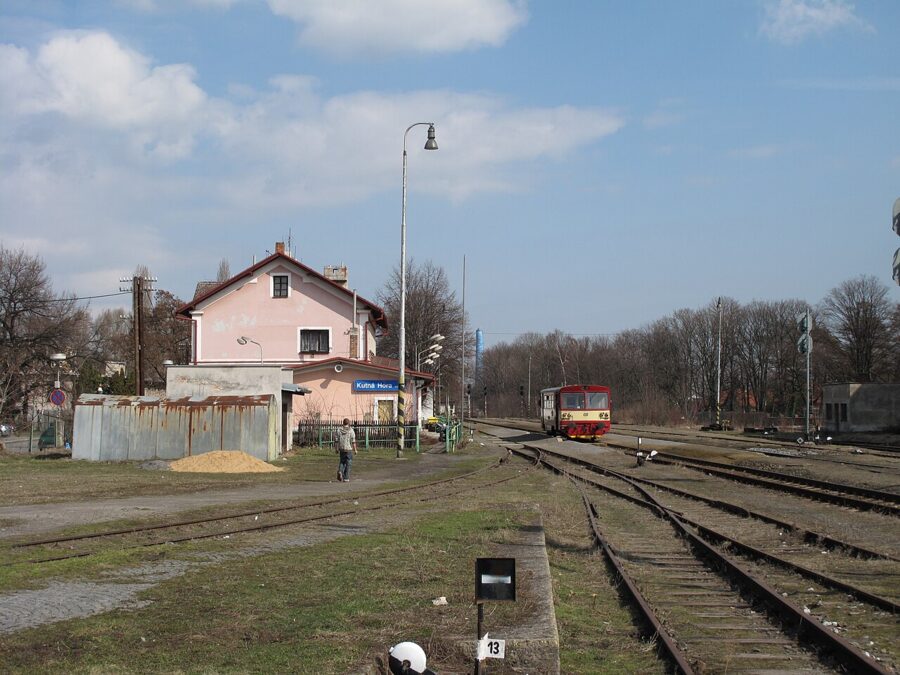
Trains leave Praha hlavní nádraží (Prague main station) for Kutná Hora hlavní nádraží through the day. Some run direct and take a little over an hour; others change at Kolín and can be quicker, at about 55 minutes. On a weekday morning in late November 2026, for example, there was a direct train at 9:46 arriving at 10:55, and a connection at 8:58 via Kolín arriving at 9:51. Check the times and fares in the IDOS timetable or with České dráhy before you go, because the national timetable changes every December.

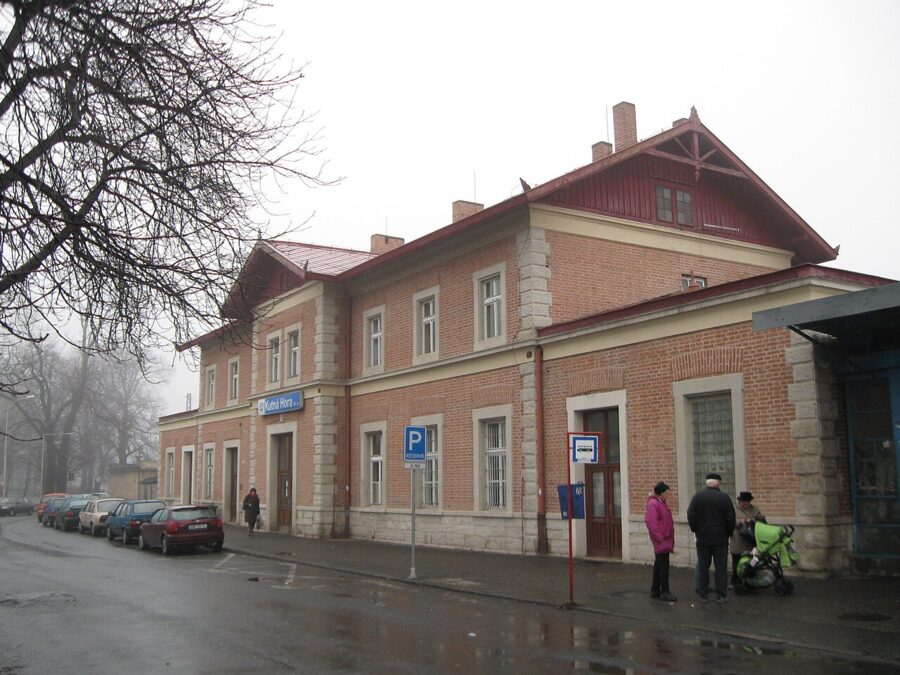
Kutná Hora’s main station is not in the town at all. It is in Sedlec, about 1 kilometer (0.6 miles) from the ossuary, a walk of 15 minutes or so. The local S28 train runs from the main station toward Kutná Hora město, the station nearest the old town, in eight minutes, and the Kutná Hora-Sedlec halt on that line is about 500 meters from the ossuary, near the cathedral.

From the ossuary to the old town is a walk of about 40 minutes, or a short ride on the local train to Kutná Hora město. If you drive, the parish says parking on Zámecká, Čechova and Starosedlecká streets near the ossuary is free. My order for a day: the first ossuary slot, the cathedral, the local train into town, St. Barbara’s and the Italian Court, then back to the main station for Prague.


The chandelier has hung over that room since about 1870. It came down once, for eight months in 2016, and went back up hung on notches instead of nails. Nobody will ever know whose bones they are, only that they asked to lie here. Book the slot, keep the phone in your pocket, and look up.